
Carbon Monoxide Release From Gas Boilers
Investigation Report, Findings, and Recommendations
Carbon Monoxide Release From Gas Boilers
Carbon monoxide (CO) remains the top-ranked technical safety risk in British Columbia and Technical Safety BC has found that certain direct ignition boilers present an increased risk of CO release indoors. Following the investigation of a 2021 incident in Maple Ridge around CO exposure in a residential building, we identified approximately a dozen subsequent incidents which revealed a recurring pattern of delayed ignitions and vent failures. The investigation identified systemic ignition and vent failure issues across multiple manufacturers, installations, and certification pathways.
Based on the findings of these investigations, we are sharing our learnings and recommendations to prevent similar occurrences.
We have also issued a new safety order, which outlines owner and licensed contractor obligations to mitigate this safety risk. This safety order will impact building owners/operators in residential and commercial settings, including, but not limited to, single family homes, schools, care homes, and recreational facilities.
Cause of the Carbon Monoxide Incidents
Our investigation into several boiler related CO incidents, including a review of the occurrences, certification requirements, and directed testing, found that direct ignition boilers, certified to CSA standard 4.9, are at an increased risk of creating CO incidents. The boilers allow for delayed ignitions which can damage the attached venting systems and continue to operate, releasing CO indoors.
Contributing factors likely include:
Dedicated delayed ignition testing completed as part of the certification process does not adequately address the potential for venting system damage.
Even with proper installation and servicing, delayed ignitions that are capable of damaging or dislodging venting systems can still occur.
The boiler designs investigated allowed for continued operation with damaged and dislodged venting systems.
Non-cemented joints were more susceptible to failure from delayed ignition, including gasketed venting joints, or boiler/vent adapters.
How To Identify an Affected Gas Boiler
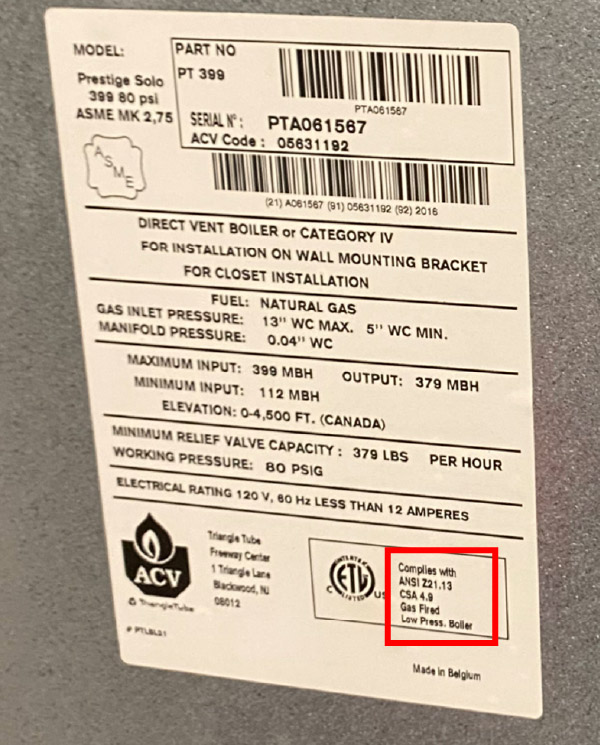
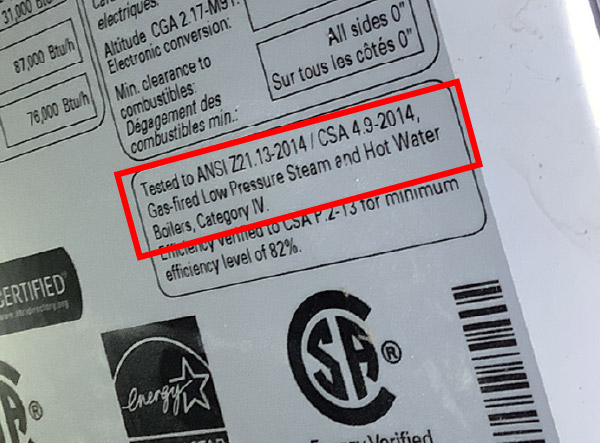
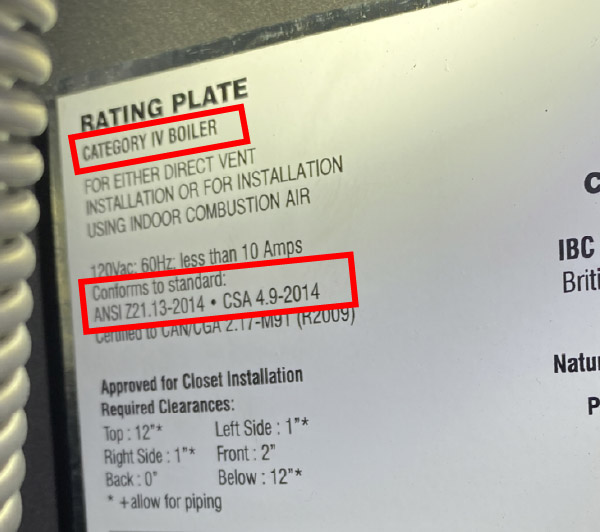
The photos below show how to identify if your boiler is related to this safety order and if it may be affected.
Report Recommendations
Based on the findings of this investigation, we have issued several specific recommendations to owners and operators of CSA 4.9-certified direct ignition gas fired boilers, licensed gas contractors, certified gas fitters, manufacturers of Category IV direct ignition boilers, and the Canadian Standards Association committee to address identified risk factors and enhance risk mitigation.
For Owners and Operators
Recommendation #1: promptly service boilers and install CO alarms
It is recommended that owners and operators of buildings with direct ignition, gas-fired boilers certified to CSA 4.9:
Retain a licensed contractor to inspect and service your boiler promptly if it has not been done in accordance with the manufacturer’s instructions. The boiler should be reinspected and serviced at least annually to reduce the risk associated with delayed ignitions. Additional information regarding servicing of gas appliances can be found on the Technical Safety BC website.
Install CO alarms in accordance with current building code and manufacturer requirements, and at a minimum, within the boiler mechanical room and in every suite of a multi-unit residential building.
For Qualified Workers
Recommendation #2: take all necessary steps to reduce the risk of delayed ignitions when working on boilers and vents
It is recommended that licensed gas contractors and certified gas fitters ensure the following when installing, servicing, or repairing any direct ignition boiler certified to CSA 4.9:
The proper functioning of all combustion and ignition related functions of the boiler, such that the opportunity for delayed ignition is minimized.
The proper support, arrangement, and integrity of venting systems and boiler-to-vent adapters such that the opportunity for damage to venting systems is minimized.
For Manufacturers
Recommendation #3: evaluate and improve boiler design
It is recommended that manufacturers of Category IV direct ignition boilers:
Evaluate new and existing designs of Category IV direct spark ignition boilers alongside approved venting materials, adapters, and configurations to determine whether field installed assemblies will safely respond to delayed ignitions.
Where necessary, implement appropriate design, control, detection, and/or installation measures for boiler designs to mitigate the risk of continued operation when venting system integrity is compromised.
For the Responsible Committee
Recommendation #4: revise applicable certification requirements
It is recommended that the committee responsible for CSA 4.9, gas-fired low-pressure steam and hot water boilers, revise the standard to include design, performance, and certification requirements so that future boiler designs are required to account for the risk of both venting failure, and continued operation following delayed ignition events.
Regulatory Resources and Appendices
The links below provide direct access to the incident report and the supporting appendices referenced throughout the document.
Safety Order
Review the safety requirements, mandatory actions, and compliance information related to the issue.
Incident Investigation
Learn what happened, which boilers are affected, and the steps taken to address the issue.
Appendix A
Other documented boiler vent failures (13 incidents involving four different boiler manufacturers, all with dislodged venting systems and up to 443 ppm CO measured in indoor occupied spaces).
Appendix B
Additional information regarding directed testing performed.
You Might Be Interested In
Carbon Monoxide Safety
Prevent carbon monoxide exposure and risk with these useful tips from Technical Safety BC.
Carbon Monoxide Exposure Results in 6 Transported to Hospital
Six residents of a multi-unit apartment building were transported to hospital for treatment of carbon monoxide (CO) poisoning.
Technical Safety BC Report Identifies Increased Carbon Monoxide Risk From Certain Gas Boilers
Province-wide measures are being implemented to help reduce carbon monoxide exposure and improve public safety.